


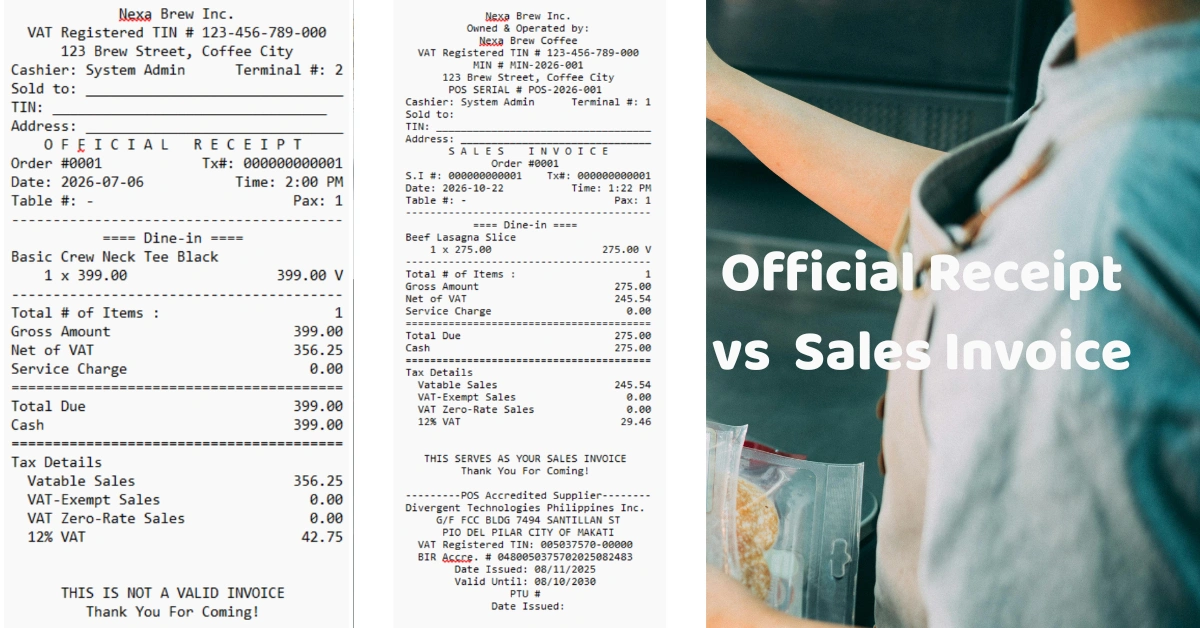
A friend of mine runs a small repair shop, and she told me about an awkward moment last year. A customer paid in cash and asked, "Can I have an official receipt?" Her cashier smiled politely and said, "Sorry, we only issue invoices." The customer looked at her like she'd just refused to give him change.
Neither of them was wrong, exactly. For decades, "official receipt" meant "the proper receipt." Since 2024, that role has gone to the invoice, and plenty of people (customers, cashiers, and even business owners) haven't caught up.
So here's a plain-English guide to the difference, what changed, when an official receipt is still used, and what your POS and paperwork should actually say. (This is general information, not tax advice, and the rules have been amended more than once, so check current BIR guidance.)
The 30-Second Answer
- Sales invoice: the main proof that a sale happened. It's the basis for the seller's output VAT and the buyer's input VAT.
- Official receipt: now a supplementary document that shows payment or collection was received.
- For buyers: an official receipt alone generally won't support an input VAT claim.
- For sellers: your POS and invoice books should say "Invoice," not "Official Receipt."
If you remember one thing, remember this: the invoice proves the sale, and the receipt proves the payment.
How It Used to Work
Before the EOPT Act
Before 2024, the system had two main documents for two kinds of sales. Sellers of goods issued sales invoices, and sellers of services issued official receipts. For services, the official receipt was also the document buyers used to support input VAT, and VAT on services was generally recognized when cash was collected.
Why It Was Confusing
If you ran a mixed business, like a restaurant that also does catering or a shop that sells products and offers repairs, you had to juggle both. Over time, people started using "OR" as a catch-all word for any receipt, whatever it actually was. That's part of why the change feels so jarring now.
What Changed
The EOPT Act and RR 7-2024
The Ease of Paying Taxes (EOPT) Act, together with Revenue Regulations No. 7-2024, made the invoice the principal document for sales of both goods and services. It applies whether the seller is VAT-registered or not. The official receipt was reclassified as a supplementary document, which means it can still be issued as proof of payment or collection but no longer serves as the main evidence of a sale. The new rules took effect on April 27, 2024.
RR 11-2024
A later regulation, RR 11-2024, amended the transition rules for unused official receipts and for businesses using POS and accounting systems. I'll walk through what it said below, since it's where most of the confusion lives.
Services Now Follow the Accrual Basis
The EOPT Act also moved sales of services to the same accrual basis that already applied to goods. In practical terms, that means the sale is recognized when the invoice is issued, not when the cash finally arrives. If you're a VAT-registered business that bills clients on credit, that timing matters, so check the details with your accountant.
A Leaner Invoice
The EOPT Act also dropped some old invoice requirements. For example, "business style" is no longer required on the invoice. Confirm the current list of required fields before you redesign your templates.
Official Receipt vs. Sales Invoice, Side by Side
Here's how the two compare:
- Role: The invoice is the principal document. The official receipt is supplementary.
- What it proves: The invoice proves a sale took place. The official receipt proves that payment was received.
- When it's issued: The invoice goes out at the sale or when you bill. The official receipt goes out when money is collected.
- VAT use: The invoice is the basis for the seller's output VAT and the buyer's input VAT. An official receipt alone is generally not valid to support input VAT.
- Typical names: Invoices go by names like sales, commercial, cash, charge, service, or billing invoice. Receipts include official receipts, collection receipts, acknowledgement receipts, and payment receipts.
- Is it required? An invoice is required for a sale. An official receipt is optional.
The invoice is also a valid source document for proving a deductible expense, which is something buyers care about at tax time.
When an Official Receipt Is Still Used
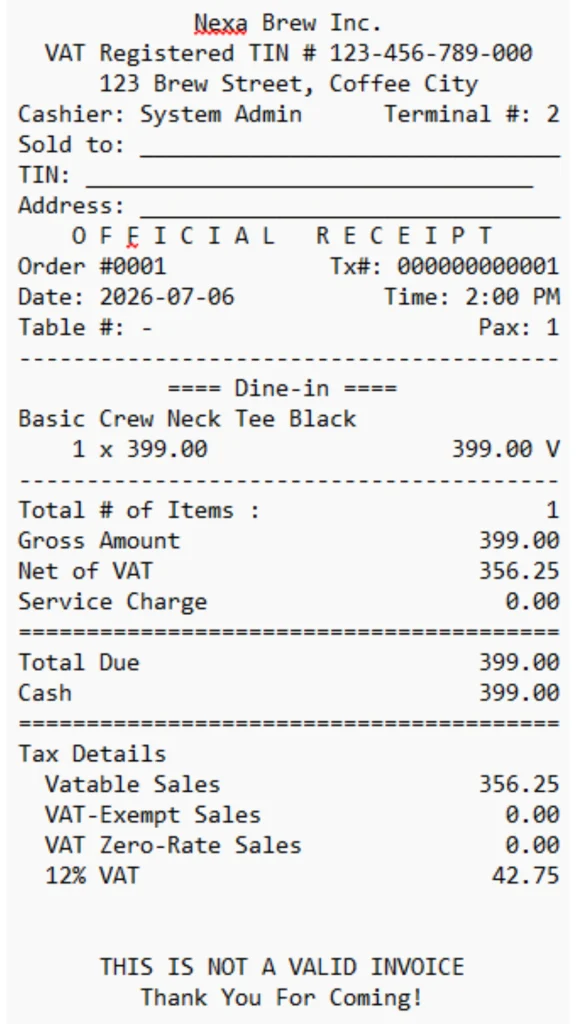
Official receipts haven't disappeared. They've just changed jobs.
Acknowledging a Payment
If you issued an invoice at the time of sale, you may issue an official receipt or acknowledgement receipt when the customer pays, instead of issuing another invoice. This is common with credit sales, installments, and deposits.
Keeping a Payment Trail
Some businesses like having a separate record of collections, and that's fine. Just make sure an invoice exists for the underlying sale.
What It Can't Do
An official receipt can't serve as the sales document, and it generally can't support a buyer's input VAT claim. A bookkeeper I know told me she once sent only official receipts to a corporate client, and the client's accounting team sent them all back asking for invoices. It was a week of back-and-forth that could have been avoided.
"Sales Invoice," "Service Invoice," or Just "Invoice"?
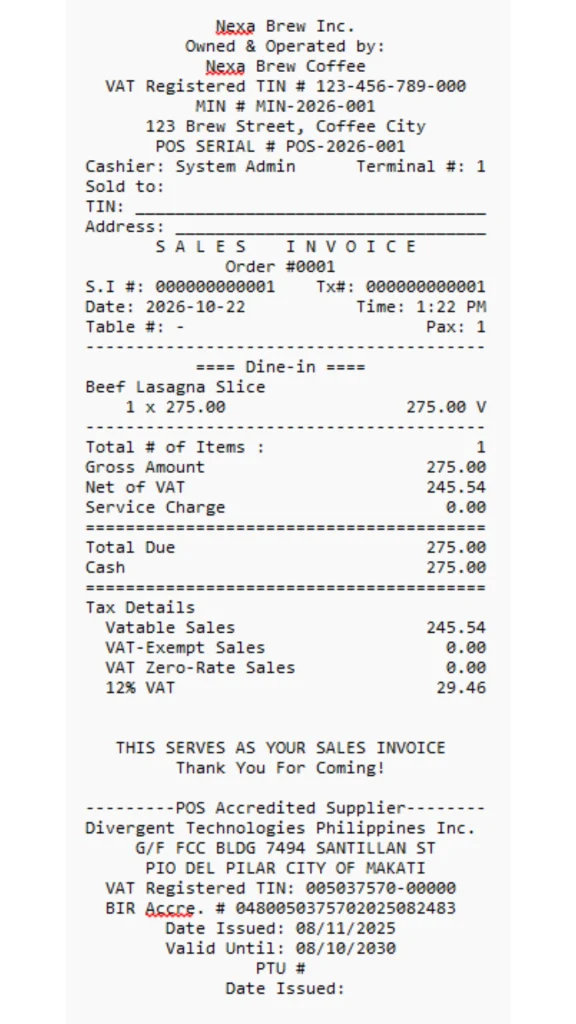
You'll see several names in use: sales invoice, cash invoice, charge invoice, service invoice, billing invoice, and others. The point isn't the exact name. It's that the document clearly says "Invoice" (or an appropriate description of the transaction) and carries the required details.
For mixed businesses, that's good news. One invoice type can cover goods and services, and you don't need to switch documents depending on what the customer bought.
What a Valid Invoice Must Contain
The full list of required information comes from RR 7-2024 and its amendments, so check the current text. In general, a valid invoice includes:
- The seller's registered name and TIN
- The word "Invoice," a serial number, and the date of the transaction
- The buyer's registered name and TIN, where required
- A description of the goods or the nature of the services
- The amount of sales and the VAT amount, with a breakdown of VATable, VAT-exempt, and zero-rated sales where relevant
- Senior citizen and PWD details when applicable. If you apply those discounts, make sure your invoices show the right fields
A newer requirement is worth knowing about too. Under RR 6-2026, invoices must show creditable withholding tax as a separate item when it applies. That mostly matters if you invoice corporate clients.
If You Use a POS, CRM, or Accounting System
Most businesses today issue receipts from a machine, not a booklet, so this part matters a lot.
What the BIR Allowed
Under RR 11-2024, businesses using cash register machines, POS systems, and e-receipting or e-invoicing software were allowed to change the word "Official Receipt" to "Invoice" or another name describing the transaction, without having to inform their Revenue District Office. The serial numbers of the renamed invoices continue from the last series of the previously approved official receipts. Documents from these machines that still said "Official Receipt" were treated as valid for the buyer's input tax claim only until December 31, 2024, or until the system update was completed, whichever came first.
Businesses using registered computerized accounting systems had a heavier job. They needed to reconfigure and update their system registration, with a December 31, 2024 deadline that could be extended by up to six months with approval.
Check Your Own Receipt
Here's a ten-second test. Print a test receipt from your POS and look at the title. If it says "Official Receipt," your system needs to be updated. Then check the serial number, your TIN, the VAT breakdown, and any senior citizen or PWD lines. Read more about BIR accreditation to make sure your system meets the basics.
Keep an Eye on E-Invoicing
Electronic invoicing is the next layer. The BIR's RMC 98-2026 retains a December 31, 2026 deadline for covered taxpayers. It doesn't automatically apply to every POS user, and micro taxpayers with gross sales under ₱3 million are exempt, so check whether you fall in a covered group. Grant Thornton has a helpful tax alert on RMC 98-2026, and you can follow the latest on BIR e-invoicing updates.
Good POS software should handle invoice wording, numbering, and reports so cashiers aren't left guessing.
If You Still Have Old Official Receipt Booklets
Plenty of small businesses still have unused booklets in a drawer. RR 11-2024 gave two options, and both let you keep using the stock until it's fully consumed.
Option 1: Keep Using Them as Supplementary Documents
Unused official receipts can continue to serve as supplementary documents, as long as each one is stamped "THIS DOCUMENT IS NOT VALID FOR CLAIM OF INPUT TAX." They still show proof of payment, but they won't support a buyer's input VAT claim.
Option 2: Convert Them Into Invoices
You can strike through the words "Official Receipt" and stamp "Invoice" (or another name describing the transaction). The converted document must show the required details: the amount of sales, the VAT amount, the registered name and TIN of both buyer and seller, a description of the goods or services, and the date. Converted documents are valid for input tax claims until the booklets are fully consumed. Taxpayers who convert had to submit an inventory of their unused official receipts, with booklet counts and serial numbers, by July 31, 2024. The professional-firm summaries are worth reading: see Grant Thornton's summary of RR 11-2024 and KPMG's InTAX note.
One more detail: you're expected to get newly printed invoices with an Authority to Print before you finish consuming the converted booklets, so don't wait until you run out.
What About Manual Official Receipts With No Stamp?
Since April 27, 2024, manual or loose-leaf official receipts issued without a stamped "Invoice" are treated as supplementary documents and are ineligible for input tax claims. If you have old booklets, check them now.
For Buyers: Why the Document Matters
If you're the one buying, the document you receive matters more than most people realize. Under RR 7-2024, the invoice is the basis for the buyer's input VAT claim and a valid source document for a deductible expense. An official receipt alone usually isn't enough.
A few habits help finance teams and small business owners:
- Ask for an invoice with your registered name and TIN when you buy for business use.
- Check that the title says "Invoice," not just "Official Receipt."
- Be wary of reimbursements based on receipts alone. If someone hands you an OR for a VAT claim, ask whether there's an invoice behind it.
When the Invoice Is Issued
Because services now follow the accrual basis, timing deserves a quick mention.
Sales of Services
The invoice date, not the date cash arrives, drives when the sale is recognized. If you bill a client in March and they pay in May, the sale belongs in March.
Partial Payments
For progress billing or installments, you invoice the billed amount, and if it's useful, you can issue a receipt for each collection. A final invoice reflects the total, less the amounts already invoiced.
Keep this part short and simple, and run your specific situation by your accountant. The rules on uncollected receivables and output VAT credits have their own conditions.
What Happens If You Get It Wrong
The consequences can be real. Under RR 11-2024, issuing official receipts without converting them to invoices for the sale of goods or services starting April 27, 2024 is treated as failure to issue an invoice. That kind of failure can carry a penalty of ₱1,000 to ₱50,000 and imprisonment, under Section 264(a) of the Tax Code. Treat the exact penalty as something to confirm with current guidance, but the practical lesson is clear: don't leave this to chance.
Common Myths
- "The official receipt is the real receipt." Not anymore. The invoice is the principal document.
- "I need both an invoice and an OR for every sale." No. The invoice is enough, and the OR is optional.
- "Only VAT-registered businesses issue invoices." Non-VAT businesses issue invoices too.
- "My POS still prints 'Official Receipt,' and that's fine." It's worth fixing.
- "I can use my old booklets any way I like." Only with the right stamps and wording.
- "E-invoicing replaces all this." It builds on it, but it applies only to covered taxpayers.
Quick Checklist
Print this and tape it near the counter:
- Does every sale get an invoice?
- Does your POS receipt say "Invoice"?
- Are old official receipt booklets stamped or converted correctly?
- Do your invoices include the required fields?
- Are your buyers getting invoices they can actually claim?
- Have you checked whether e-invoicing covers you?
Who Feels This Most
The shift hit service businesses hardest, since they were the ones relying on official receipts. If you run a salon, spa, or laundry shop, check that your system is issuing invoices properly. A salon POS system, spa POS system, or laundry POS system should handle service billing without you juggling two document types. Retailers and food businesses felt it too, so if you run a shop or restaurant, take a look at your retail POS system or restaurant POS system settings. For a broader explanation, PwC Philippines has a clear note on EoPT invoicing.
Frequently Asked Questions
Is the official receipt still valid in the Philippines?
Yes, but as a supplementary document that shows payment or collection. It's no longer the principal document for a sale.
What is the difference between an official receipt and a sales invoice?
A sales invoice is the principal document proving a sale and supports the seller's output VAT and the buyer's input VAT. An official receipt is a supplementary document showing that payment was received.
Can I claim input VAT with an official receipt?
Generally no. An official receipt alone doesn't support an input VAT claim. You need an invoice with the required details.
Do I need to issue both an invoice and an official receipt?
No. The invoice is the required document. You may also issue a receipt when you collect payment, but it's optional.
Can I still use my old official receipt booklets?
Yes. You can keep using them until they're consumed, either as supplementary documents with the "not valid for claim of input tax" stamp, or by converting them into invoices with the required stamp and information.
Do non-VAT businesses need to issue invoices?
Yes. Under the EOPT rules, the invoice is the principal document for sales whether the seller is VAT-registered or not.
Final Thoughts
The official receipt versus invoice change sounds technical, but the idea is simple: one main document for the sale, and an optional supporting document for the payment. Once your POS, your booklets, and your team's habits all line up with that, the confusion fades.
Here's a small challenge for this week. Print one test receipt from your POS, and read the title and the details out loud. If anything looks outdated, you've just found your first fix.
And if you'd like to see how a BIR-accredited POS handles invoices, numbering, and reports, book a free demo and try your own scenarios. If you have questions about your current setup, you can also contact us.
